芭蕾舞星成名史
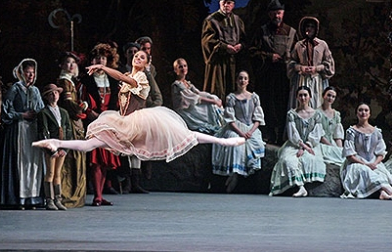
A basketball court is an unusual place to dance ballet(芭蕾舞). But it was on a court at a Boys and Girls Club in San Pedro, California, that Misty Copeland took her first ballet class at thirteen. “It was a free class,” Copeland told TFK. “It was the first time I had those chances given to me.”
Cynthia Bradley, a ballet teacher, wanted to reach out to young people who might not otherwise have the chance to study classical ballet. “When I was introduced to ballet,” says Copeland, “it sparked(激发) this new way of looking at things.”
Now Copeland, 33, is helping others see classical dance and ballet dancers in a new way. She’s now a top dancer at a leading international ballet company. She’s inspiring others to follow in her beautiful footsteps.
Bradley encouraged Copeland to take classes with her at the San Pedro Ballet School. Two years later, Copeland was accepted into a summer program with the San Francisco Ballet. By 17, she had moved to New York City to take part in special training with the American Ballet Theatre (ABT), one of the world’s leading ballet companies.
At ABT, Copeland was the only African-American woman in a company of 80 dancers. “For so many generations, ballet dancers have been seen as these very frail(瘦弱的), thin white women,” she says. Copeland is proud to set an example that you don’t have fit a mold(模子) to succeed. “You can be who you are,” she says. “You don’t have to look like the person next to you. I think that’s important for kids to understand.”
For years, Copeland paid her dues in small roles at ABT. She bounced back after a serious injury in 2012. On June 30, 2015, Copeland became the first African-American woman to be a principal dancer in ABT’s 75-year history.