要知道树龄就得把树砍掉数年轮?不,还有其他办法。
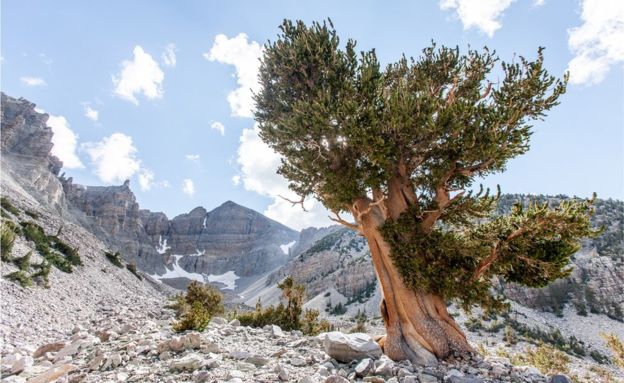
What is the oldest living organism on the planet? For scientists, accurately proving the age of any long-lived species is a hard task.
Under a 300-year-old sweet chestnut tree in the Royal Botanic Gardens in Kew, Tony Kirkham confirms that trees live a long time. Proving this can involve some traditional detective work, as he explains,"First of all, we can look at previous records, to find out if a tree was growing there at a set date. Then we look at paintings and artwork, to look to see if that tree was present. And old survey maps quite clearly show ancient trees, especially important ones."
A well-known way of measuring the age of a tree is by counting the rings in its trunk: one ring per year of growth. It only works for certain types of trees that have an annual growth spurt. The obvious problem is that counting rings normally involves cutting down the tree.
Scientists get around this by using a drill that allows them to take out a core, and count the rings without fatally damaging the tree. It's a delicate art, and, Tony says, back in the 1960s, one scientist's drill broke off inside the pine tree he was sampling. The kit is expensive, and to help him recover the lost instrument, people helpfully cut down the tree. Once fell, the tree could be easily aged, and was found to be 5,000 years old.
A team of researchers in Britain keep a list, called the Old List, of officially dated ancient trees. They've found a fig tree in Sri Lanka that is at least 2,222 years old. There's a Patagonian cypress tree in Chile which, at 3,627 years old, is as old as Stonehenge. A Great Basin pine in California's White Mountains comes in at 4,850 years old. But the oldest tree on the list, an unnamed pine from the same location, has a core suggesting it is 5,067 years old.
本时文内容由奇速英语国际教育研究院原创编写,未经书面授权,禁止复制和任何商业用途,版权所有,侵权必究!(投稿及合作联系:028-84400718 QQ:757722345)