370万年前的“熊脚印”被证实属于早期人类
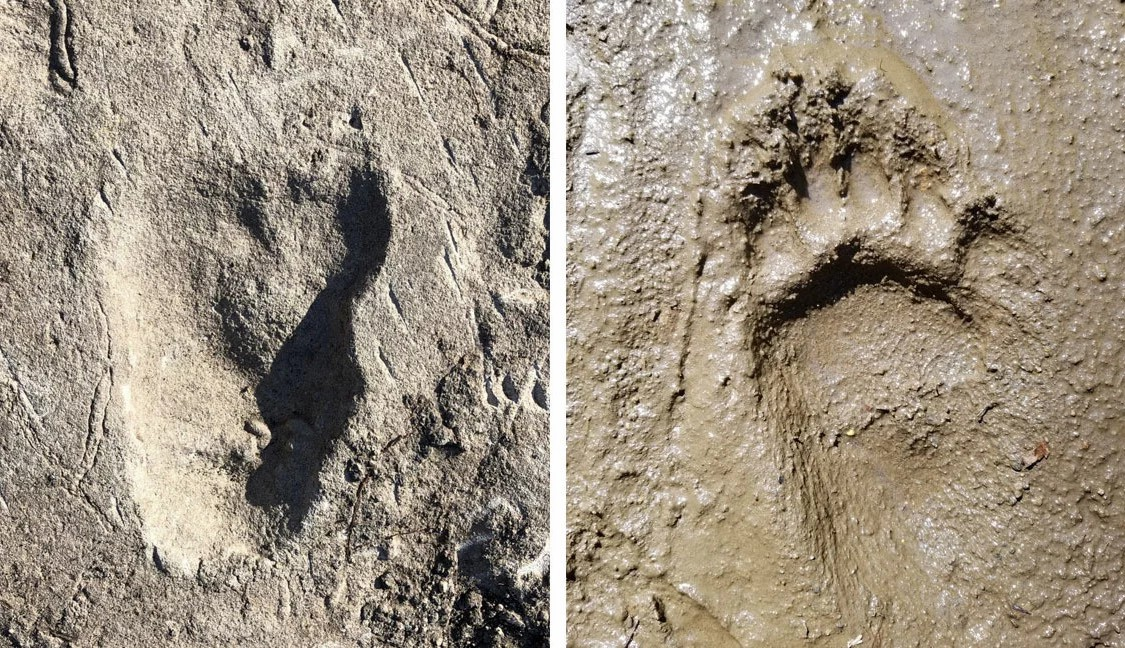
The early humans who walked the Earth nearly 3.7 million years ago were not walking alone. Fossil footprints in Tanzania reveal that two human species once lived in the same place at the same time.
Scientists had long thought that one set of unusual prints there was left by a bear walking on its hind legs, but a new analysis published in the journal Nature suggests that’s not right. Instead, it shows that the tracks were left by some unknown early human species that was wandering around that spot at the exact same time as Australopithecus afarensis(南方古猿阿法种) — the species of the famous partial skeleton(骨架) “Lucy”.
Australopithecus afarensis has long been assumed to have been the only human species living way back then, and scientists have considered it an ancestor of modern humans. But recent discoveries of other remains, such as jaws, skulls and foot bones, have implied that an unexpected diversity of hominins(古人类) may have lived during this period.
These ancient footsteps were trapped by a volcano. At this particular site, at Laetoli in northern Tanzania, all the footprints were made in the same layer of mud. That means individuals from these two early human species must have passed through within hours or days of one another, says Ellison McNutt, a biological anthropologist. It’s possible that the unknown species that made the unusual footprints “looked up across the landscape and saw an Australopithecus afarensis walking somewhere else,” she says. “It’s really cool that we may have two hominin species, at least, living at the same place.”
Walking on two legs is a unique and distinctive human characteristic. “It’s a very strange way of kind of moving through the world, and it’s very different from other animals,” McNutt notes, adding that how and why humans evolved to do this is still a mystery. “This seems to be one of the things that sort of makes hominins very different from the other living primates(灵长类).”
本时文内容由奇速英语国际教育研究院原创编写,未经书面授权,禁止复制和任何商业用途,版权所有,侵权必究!(作者投稿及时文阅读定制请联系微信:18980471698)