2023年搞笑诺贝尔奖出炉,今年哪个科学家的脑洞最大?
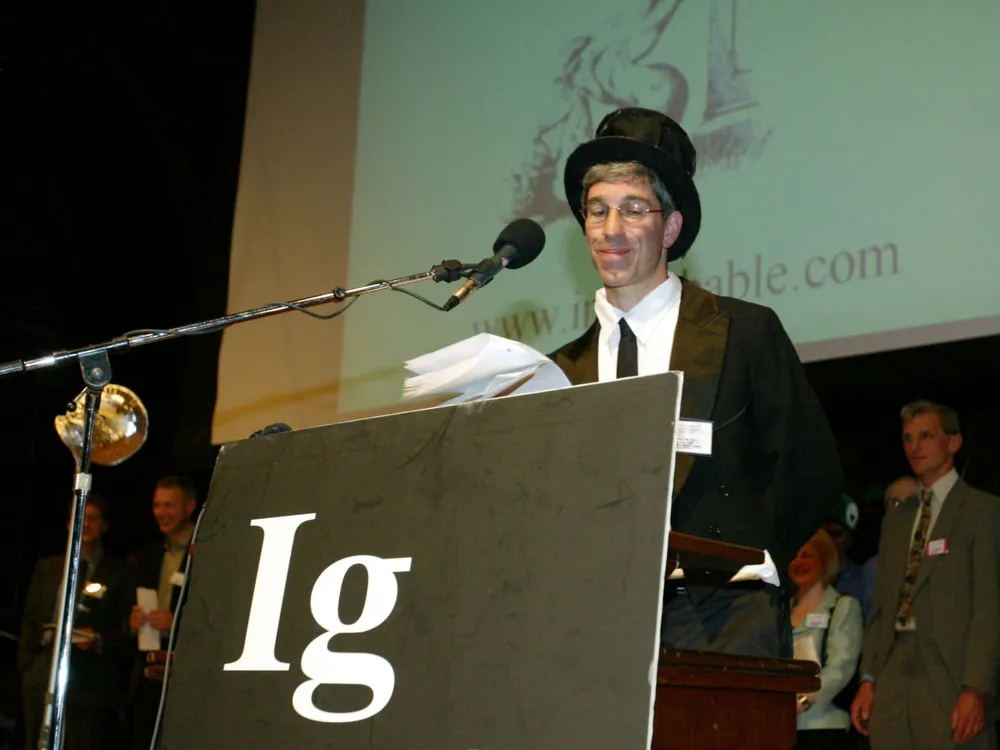
On Thursday, the ceremony for the 33rd annual edition of the Ig Nobel Prizes took place, rewarding scientists “for achievements that first make people laugh, then make them think.” Below is a summary of this year’s some award-winning research projects.
Licking rocks and reanimating (赋予新的生命) spiders
Geologist Jan Zalasiewicz took home the chemistry and geology prize for a 2017 essay explaining why scientists sometimes lick rocks. It’s “part of the geologist’s armory (法宝) of tried-and-much-tested techniques used to help survive in the field,” he writes in the essay “Eating Fossils”. Wetting the surface of a fossil or rock allows mineral particles and textures to stand out. Zalasiewicz was “bemused” to find out he won the award, because he didn’t think he would win the award.
Researchers who experimented with using dead spiders as a gripping mechanism (机械装置) received the mechanical engineering award. They found that spiders’ legs, which extend using hydraulic (液压的) pressure, can be manually opened from their natural, closed state by applying pressure. “The gripper is capable of grasping objects with irregular geometries and up to 130 percent of its own mass,” the authors write in the study, published last year in Advanced Science.
Smart toilets, nose hairs and electric chopsticks
The public health prize honored the invention of the Stanford toilet by urologist Seung-min Park, which studies human waste for signs of illness using a range of technologies — from cameras to motion sensors to medical sensors.
The medicine prize went to researchers who counted the nose hairs of dead bodies. People with alopecia (秃头症), or hair loss, can lose their nose hair, and the scientists want to learn how this impacted their health.
Researchers won the nutrition prize for attempting to make food tastier with electrified chopsticks and straws. “The taste of food can be changed immediately and reversibly (可逆地) by electrical stimulation, and this is something that has been difficult to achieve with conventional ingredients,” recipient Hiromi Nakamura tells the Guardian.